Tesla brought its first Giga Press online in 2020 at the...Continue reading→


Michigan Business – News – History
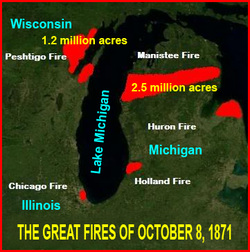
On the night of October 8, 1871, as the nation fixated on flames consuming Chicago, an even larger catastrophe was unfolding to the north. Michigan was burning—entire towns erased, forests converted into roaring furnaces, and thousands of people forced to run for their lives under a sky the color of tarnished copper. It was one of the most destructive firestorms in American history, yet it slipped through the cracks of national memory. The story that followed in Michigan was not simply a fire. It was a perfect collision of drought, industry, human error, and nature’s fury.

The summer leading up to the disaster gave Michigan every warning possible. Heat and drought lasted for months, leaving the ground baked and brittle. Rain barely fell. Farmers along the Thumb and western shoreline watched crops curl into dust. Rivers shrank. Even Lake Michigan’s levels fell noticeably, exposing sandbars and lake bottom normally hidden beneath the waves.
But the real danger came from the logging industry. By 1871, Michigan was the world’s leading supplier of white pine. Logging companies swarmed the forests, cutting enormous swaths through the interior. They worked fast and left faster—leaving behind mountains of slash: branches, tops, needles, bark, and stumps. Under normal conditions, these scraps were merely messy. Under the extreme dryness of 1871, they were explosives waiting for a spark.
Small fires became a fact of life. Settlers burned brush to clear land. Trains dropped hot embers along railways. Farmers burned piles of slash because it was the only practical way to clear it. Logging camps burned debris every day. None of it seemed risky—until the wind came.
On the morning of October 8, winds whipped out of the southwest at alarming speeds. Some survivors later claimed they heard a low, distant roar long before they saw flames. Others noticed smoke thickening along the horizon, stretching for miles. A cold front was sweeping across the Midwest, dragging fierce winds with it. Those winds didn’t simply fan existing fires. They merged them, guided them, and eventually transformed them into a single, unstoppable firestorm.
The western towns along Lake Michigan were among the first hit. Holland, a growing Dutch community with tidy wooden homes and a thriving business district, was surrounded by forests full of logging slash. When the wind shifted, flames raced toward the city at a speed the townspeople had never seen. Witnesses described the fire as a moving wall—twenty to thirty feet high, glowing red at the base and black at the top as it consumed everything in its path. Embers leapt from rooftop to rooftop. Families fled toward Lake Macatawa or ran directly into the waves of Lake Michigan.
By dawn the next morning, Holland was little more than foundations and smoking ash.
Manistee suffered a similar fate. The fire moved so quickly that some residents barely made it to the river. Ships anchored offshore reported seeing people swimming into the water as burning logs and boards rained down around them. Like Holland, Manistee’s lumber mills, homes, and downtown were flattened before sunrise.

As the fire burned west to east, it grew. The Thumb region—dry, flat, and filled with homesteads—was a perfect funnel. Near Port Huron, conditions turned nightmarish. The air grew thick with smoke so dense that people could barely see a few feet in front of them. Horses panicked, wagons overturned, and entire families ran blindly through the darkness trying to outrun the heat behind them. Some made it to the St. Clair River and waded into the water. Others sought shelter in wells or root cellars, clutching wet blankets over their heads. Many survived only by diving into muddy ponds and staying submerged until their lungs burned for air.
The town of White Rock was completely erased. Positioned along the shore of Lake Huron, with only a few dozen buildings and a lighthouse nearby, it had no chance once the firestorm crested the ridge west of town. Survivor accounts describe the fire arriving as if the sky itself had opened and dropped flames straight downward. Houses ignited instantly. Trees exploded. Families sprinted toward the beach, running into the lake as the fire rolled over the shoreline. The lighthouse keeper, Charles W. Drew, became a local hero after leading dozens of people into the water and keeping them alive overnight.
Some parts of the Thumb experienced what historians later called “fire tornadoes.” As the superheated air collided with cooler winds, it spun into vortexes that lifted burning debris hundreds of feet into the air. These weren’t metaphors. They were literal spiraling columns of fire, powerful enough to rip roofs off homes and hurl them into fields miles away.
Even Detroit, far from the major fire paths, felt the effect. The sky turned thick and brown. Ash fell across the city. Reports described the sun as a dark red disc, barely visible through the haze. Many residents feared an eclipse or an omen.
By the time rain finally arrived on October 9, thousands of square miles had burned. Some estimates suggest that the Michigan fires consumed more territory than the Chicago Fire, the Peshtigo Fire (in Wisconsin), and the Minnesota wildfires—combined. The truth is murky because recordkeeping was inconsistent, but it was undeniably one of the worst fire events in North American history.
Yet, remarkably, Michigan’s tragedy was overshadowed almost instantly.
Chicago’s burning skyline grabbed national headlines the following morning. Its population, wealth, industry, and political connections made it the center of attention. Newspaper editors focused nearly exclusively on the Chicago story. By the time word spread of the destruction in Michigan, the nation’s attention was already elsewhere.
In Michigan, the aftermath was grim. Entire counties were scarred. Farmers lost barns, livestock, and crops. Timber towns lost their mills, which were often the only source of local income. Roads were gone. Telegraph lines melted. Thousands of people were left homeless, relying on aid from Detroit, Cleveland, and even Toronto. Relief committees formed in Port Huron and Saginaw. Churches opened their doors to refugees, and Great Lakes ships arrived with food, clothing, and blankets.

Investigations began almost immediately. While most experts blamed the drought, the winds, and the massive amounts of logging slash, others reached for stranger explanations. The most popular theory was that debris from Biela’s Comet had struck the atmosphere, triggering synchronized fires across the Midwest. It was an imaginative theory—complete with fiery space fragments showering the region—but not a scientific one. Still, it reflected the sheer scale and strangeness of the fires that night. People looked for answers beyond the ordinary because the ordinary explanation felt too simple for such devastation.
Out of the ashes, Michigan changed. Fire codes were revised. Logging practices improved, at least marginally. Settlers became more cautious about burning land. And slowly, over decades, towns rebuilt. Holland’s residents reclaimed their home and eventually turned their rebuilt community into the iconic Dutch-inspired city known today. Manistee grew into a vibrant port city. The Thumb returned to farming. But the memory of the fire lived on in families through stories passed down from grandparents who had survived the night the sky caught fire.
Today, the 1871 Michigan firestorm remains both monumental and strangely forgotten. Chicago’s fire captured the headlines. Wisconsin’s Peshtigo Fire captured the historical spotlight. Michigan’s disaster, enormous as it was, slipped between them—overshadowed by geography, timing, and the limitations of 19th-century journalism.
But for the people who lived here, the story was never forgotten. It shaped the landscape, redirected the state’s economy, and left behind tales of terror, resilience, and chance survival. It was one of the greatest natural disasters in Michigan history, and its scale deserves to stand alongside the other great fires of 1871.
In many ways, it was Michigan’s darkest night—one the nation missed, but the state will always remember.
Bibliography
"The Great Michigan Fire of 1871," Michigan History Magazine, 2015, https://www.michigan.gov/mhc
"Michigan’s Other Great Fire," Traverse Magazine, Patrick Sullivan, Oct 2016, https://www.mynorth.com
"1871: The Year of Fire," Michigan State University Extension, Theresa Neal, 2017, https://www.canr.msu.edu
"The Firestorm of 1871," Thumbwind, Michael Hardy, 2020, https://thumbwind.com
"History & Tragedy of the Great Fires," Wisconsin Historical Society, 2018, https://www.wisconsinhistory.org
"The Burning of Holland, 1871," Holland Museum, 2019, https://hollandmuseum.org