What is the AI powered Applicant Tracking System and how NOT to get rejected!
The Problem: The Digital Gatekeeper
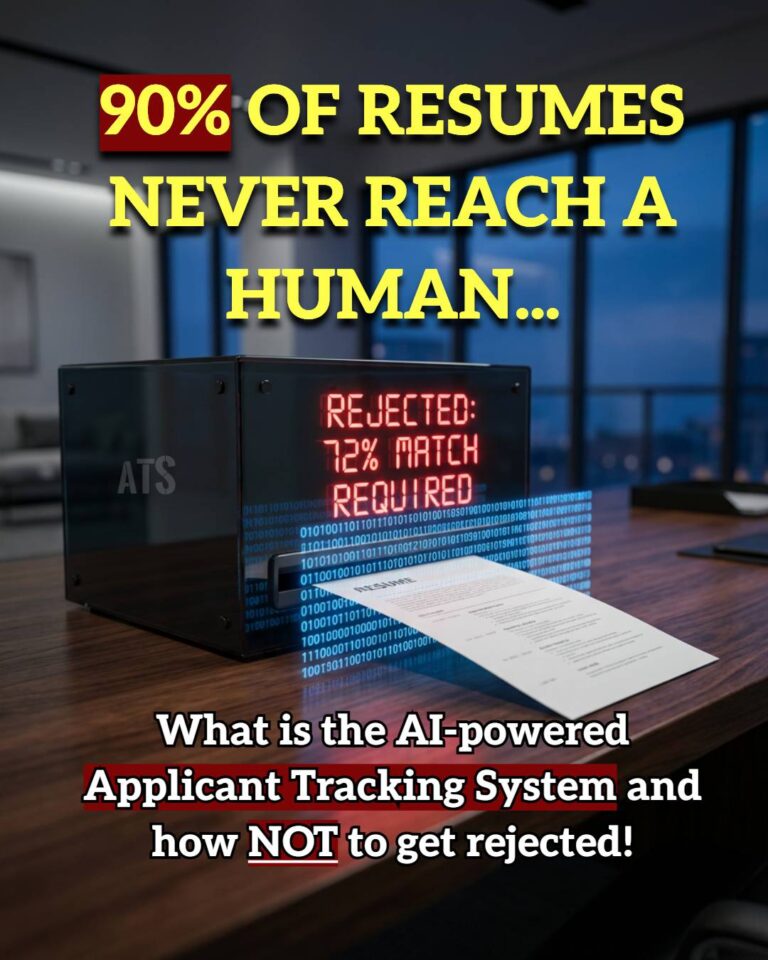
In the 2026 hiring market, the greatest barrier to your next role isn’t a lack of talent - it’s a lack of searchability. Studies show that up to 90% of resumes submitted through job sites NEVER make it to a real live person.
Most organizations now use the Applicant Tracking System (ATS) as a digital ‘bouncer’, not a talent scout. These systems aren’t looking for the “best” person; they are looking for the “safest match” based on pre-programmed parameters. If your resume uses a complex layout, lacks “Exact-String” keywords, or fails “Knockout” logic, you are invisible before a human ever logs in. You aren’t being rejected because of your skills, you’re being filtered out because of your formatting.
The Objective: Algorithmic Alignment
Getting hired is no longer just about your resume; it’s about data integrity. By moving from passive descriptions to active proof, you shift your profile from a “Maybe” to a “High-Match” ranking. This guide provides the blueprint to reverse-engineer those automated filters and turn the “Apply” button into a bridge, not a black hole.
The Core Pillars of Success:
- Prompt Engineering: Utilizing LLMs (Large Language Models) to audit Job Descriptions and identify hidden “Knockout” requirements before you apply.
- Evidence-Based Metrics: Moving beyond “responsibilities” and anchoring every claim in a specific number, tool, or result.
- Parsing Integrity: Ensuring your document structure (Single-Column .docx) is technically compatible with 2026 parsing logic.
- Platform Specificity: Tailoring your strategy to the unique “Matching Engines” of LinkedIn, Indeed, and ZipRecruiter.
The Goal
This guide is not about “gaming” the system. It is about transparency. It ensures that the value you provide is accurately translated into the language that modern hiring software understands.
Stop writing for the machine. Start speaking its language so you can get to the human.
The Invisible Bouncer: Why Your Resume is Getting Ghosted (and How to Fix It)
If you’ve applied for dozens of jobs and received nothing but automated rejections within minutes, you aren’t failing exactly, you’re being filtered.
In 2026, a human recruiter rarely sees your resume first. That job belongs to the Applicant Tracking System (ATS). Think of the ATS as a digital bouncer. It’s a search engine programmed with “Knockout Rules.” If your resume doesn’t have the exact strings the recruiter is hunting for, or if your formatting “breaks” the machine, you are invisible before the first round even begins.
To win, you have to stop writing for humans and start optimizing for the machine so that a human eventually gets the chance to meet you.
The “ATS Architect” Prompt (Version 2.0)
The biggest mistake job seekers make is guessing what keywords matter. Use this prompt to reverse-engineer any Job Description in seconds. Copy and paste this into an AI like Gemini or ChatGPT:
[PROMPT]
Act as a Senior Recruiter and ATS Analyst. I am providing a Job Description and my Resume below. Your goal is to reverse-engineer the automated filters and ‘Knockout’ (KO) rules programmed into the hiring software for this role.
Instructions:
- Be Direct: No fluff or generic career advice.
- Be Specific: Back up every claim with a concrete detail or example.
- Logical Gap Check: Identify “implied” skills (e.g., if they mention ‘volatile supply chains,’ they are looking for ‘crisis management’).
Provide:
- The ‘Bouncer’ Checklist: Identify 3–5 ‘Hard Requirements’ (certifications, years, or tools) that trigger auto-rejection if missing.
- Exact-String Match: List the top 10 technical terms from the JD that are missing or weak in my resume.
- The ‘Proof’ Upgrade: Rewrite my two most relevant resume bullets using the ‘Action Verb + Metric + Tool’ formula.
- Formatting Audit: Identify any elements in my resume (columns, headers, tables) that might “break” a standard parser.
- The Ranking Gap: What is the one specific “high-value” detail I can add to move into the top 10% of candidates?
Job Description: [PASTE JOB DESCRIPTION HERE]
Resume: [PASTE RESUME HERE]
The User Guide: How to Weaponize the Results
Running the prompt is step one. Here is how to execute the data:
- Survival (The Checklist): If the AI identifies a “Hard Requirement” you actually have (like a specific software), move it to the top third of your resume. The ATS often prioritizes keywords found near the top.
- Discoverability (Exact Strings): The machine is looking for a character match. If the JD says “Customer Relationship Management” and you wrote “CRM,” change it to match the JD exactly.
- Authority (The Upgrade): Replace vague tasks with results. “Managed leads” becomes “Generated 200+ qualified leads/mo. (12% conversion) via LinkedIn/HubSpot.”
Visual Breakdown: Parsed vs. Broken
Recruiters don’t see your beautiful Canva template. They see a “Parsed” text version of your file.
- The “Broken” Resume: Uses a two-column layout with a sidebar for skills and a fancy header for contact info.
- The Result: The ATS reads left-to-right across the whole page. It jumbles your “Skills” into your “Work History,” creating a garbled mess of text that the search engine can’t index. Rank: 0.
- The “Parsed” Resume: A clean, single-column .docx file with standard headings (Experience, Education, Skills).
- The Result: The ATS identifies every date, job title, and keyword perfectly. Your name shows up at the top of the recruiter’s search results with a “95% Match” score. Rank: Top 10%.
Bonus: Platform Cheat Codes (2026 Edition)
The Truth About ATS: Why the “Disconnect” Exists
When you hear a recruiter say, “I look at every resume,” they are often being sincere, but they are describing their intent, not the mechanical reality of the software. Here is the breakdown of how the disconnect happens in 2026.
1. The “Semantic” Shield: Filter vs. Reject
Recruiters often argue they don’t “auto-reject” because they technically have to click the final “Archive” button themselves.
- The Fact: Modern ATS platforms (like Greenhouse or Workday) use AI Fit Scoring to rank a pile of 500 applicants. If the system gives you a 20% match score because of a keyword mismatch, you are moved to the bottom of a digital stack. While the recruiter didn’t “reject” you, they will likely never scroll far enough to see you. For the candidate, the result is the same as an auto-rejection: silence.
2. The “Knockout” Reality
- The Fact: Almost every enterprise system uses Knockout Questions. These are the “Yes/No” filters you answer during the application (e.g., “Do you have 5+ years of experience with ERP software?”). If the recruiter has marked a requirement as “Mandatory” and you select “No,” the system can be set to auto-archive your application instantly. This is a deliberate, automated barrier that happens before a human ever logs in.
3. The Parsing Failure (The “Invisible” Candidate)
- The Fact: If a resume uses complex columns, text boxes, or headers/footers for contact info, the ATS “Parser” (the engine that reads the text) often scrambles the data.
- The Result: To a recruiter, your profile looks like a jumbled mess of broken code or missing dates. They won’t spend 10 minutes trying to decode a broken file; they simply move to the next clean, single-column profile. You weren’t rejected for your skills; you were rejected because the machine made you unreadable.
4. The “AI Fit Score” and Triage
- The Fact: In 2026, systems like Eightfold.ai and MokaHR use “Skills Inference.” They don’t just look for keywords; they look for the intent and scale of your work. If your resume lacks the “Action + Metric + Tool” formula, the AI assigns a low “Competency Score.” In a high-volume environment, recruiters use these scores to “triage” their day, focusing only on the “Top 5%” the AI recommends.
Final thought…
The ATS is not a “Terminator” designed to kill your career. It is an intelligent, AI-powered Search Engine designed to manage chaos. If you aren’t optimized for that search engine, you aren’t “bad” at your job, you’re not ‘unqualified’, you’re just, well, unfindable. Follow the advice in this guide, and land that interview!






 BodhiJack’s Pearls of Wisdom…