Well-designed processes often fade into the background when they work. This article explains why systems are noticed only when they fail—and what that reveals about how organizations function.
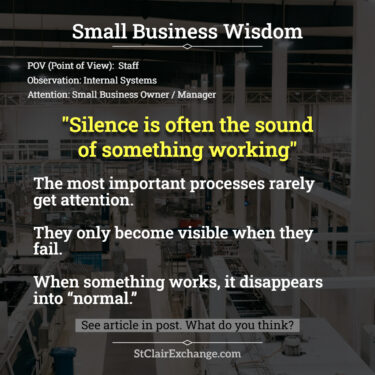
Processes are noticed only when they fail, rarely when they succeed.
It sounds obvious at first. Then you start looking around and realize how much of daily work depends on systems no one mentions. Orders move. Emails route correctly. Payroll runs. Equipment starts. Customers receive what they expected. Nothing happens—and that’s the point.
When a process works, it produces continuity, not drama. There’s no interruption to explain, no meeting to schedule, no language to attach meaning to it. The system fades into the background, absorbed into the assumption that “this is just how things go.”
That invisibility is not accidental. Human attention is drawn to disruption. We notice friction, delay, and failure because they demand response. A broken process interrupts momentum and forces a decision. A functioning one quietly removes the need to think about it at all.
Success doesn’t announce itself. Failure does.
This is why functioning systems are often credited to people rather than structure. When things go well, the outcome is attributed to effort, competence, or goodwill. The process that made consistency possible remains unnamed. Only when results wobble does the system itself become visible.
Failure reframes the process as an object. Suddenly it has edges. It can be pointed at, discussed, and redesigned. Ironically, this scrutiny often arrives after long periods of reliability, as if the failure erased its entire history.
There’s a subtle imbalance here. Broken processes receive urgency. Working ones receive silence.
That silence has consequences. Maintenance feels optional when nothing is obviously wrong. Documentation seems unnecessary when everyone “already knows” how things work. Redundancy appears inefficient until the single point of failure announces itself.
Smooth systems rarely generate praise. They generate assumptions.
Over time, this shapes how organizations allocate attention. Energy flows toward visible problems rather than invisible safeguards. Improvements are driven by breakdowns instead of foresight. The absence of complaints is mistaken for the absence of process, rather than evidence of one functioning well.
This pattern repeats across contexts. In customer experience, people remember confusion more vividly than clarity. In operations, downtime carries more weight than years of uptime. In communication, misunderstandings are dissected while successful exchanges pass without comment.
None of this is malicious. It’s perceptual. Continuity feels normal. Interruption feels meaningful.
The risk emerges when silence is interpreted as proof that systems don’t matter. In reality, silence is often the reward of careful design. A process that works removes itself from awareness by reducing decision-making, friction, and error. Its success lies in how little it demands from the people around it.
Reliability is easy to overlook precisely because it does its job.
When failure finally arrives, the response is often reactive. Systems are questioned, replaced, or complicated without recognizing what previously worked. The conversation starts at the point of pain, not at the longer arc of function that preceded it.
Understanding this dynamic doesn’t require dramatic change. It requires noticing what hasn’t demanded attention lately—and why. The most important processes are often the ones no one is talking about.
They aren’t absent. They’re quiet.
PRACTICAL TAKEAWAYS
-
Systems that function well tend to disappear from awareness, even as they carry most of the workload.
-
Silence and lack of complaints often indicate reliability, not irrelevance.
-
Failures reveal processes, but they don’t define their entire value.






 BodhiJack’s Pearls of Wisdom…