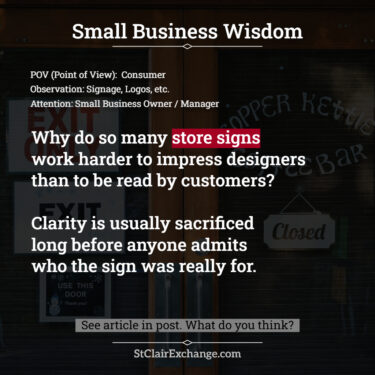
Many signs fail not because of poor intent, but because clarity is quietly traded for taste, internal comfort, or abstract ideas of branding.
Most signs are created with good intentions. Someone wants them to look professional, modern, or aligned with a brand. Fonts are chosen carefully. Colors are debated. Spacing is refined. Somewhere along the way, the original purpose quietly slips.
The sign was meant to be read.
Instead, it becomes something to admire.
This is how clarity is usually lost—not through negligence, but through a series of small, reasonable decisions that favor appearance over comprehension. Each choice makes sense in isolation. Together, they produce something that works harder to impress designers than to serve customers.
Unreadable signage is rarely the root problem.
It is a visible symptom of a deeper pattern.
In many organizations, clarity competes with internal comfort. Clean lines feel safer than blunt language. Minimal text feels more sophisticated than explicit instruction. Abstract branding feels more refined than saying exactly what something is or how it works. No one intends to confuse anyone. Confusion simply isn’t loud enough to stop the process.
Customers, meanwhile, make decisions under imperfect conditions. They are standing, walking, distracted, tired, or in a hurry. Lighting is uneven. Angles are awkward. Time is limited. In these conditions, clarity either shows up immediately—or it doesn’t show up at all.
Design assumes ideal attention. Reality never provides it.
When signs fail, customers rarely complain. They hesitate. They guess. They walk away. They make small errors that compound quietly. Because there is no obvious moment of failure, the system continues unchanged. The sign remains. The confusion becomes normal.
This pattern does not stop at signage.
It appears in written communication that favors tone over meaning. In offers that are technically accurate but cognitively heavy. In systems that make sense to the people who built them, but not to the people navigating them for the first time.
Small confusion compounds without protest.
Each unclear step increases friction. Each moment of hesitation drains trust. None of it is dramatic enough to demand correction. Over time, the cost becomes real, even if it is never directly measured.
What makes this pattern persistent is that the wrong audience often dominates the decision-making. Designers review signs. Teams review copy. Internal stakeholders approve systems. The people who must understand the result are rarely present when clarity is negotiated away.
This leads back to a useful question—one that is almost never asked directly:
Who was this really for?
Not in theory. Not in a brand document. In practice.
Was it for the customer encountering it for the first time? Or was it for internal alignment, aesthetic satisfaction, or the quiet relief of avoiding bluntness? These motivations are understandable. They are also expensive.
Clarity is not presentation. It is respect.
It respects the reader’s time. It respects their limited attention. It respects the fact that most decisions are made quickly, imperfectly, and without context. Clear communication does not demand effort from the audience to decode intent. It meets them where they are.
This does not mean abandoning taste or design. It means subordinating them. When clarity and style conflict, clarity has already lost too many times without anyone noticing.
A readable sign does its job and disappears. An unreadable one becomes a conversation piece—usually after it has already failed.
The same is true for communication, offers, and systems. When things work, they attract little praise. When they don’t, people quietly adapt or leave. The signal is subtle. The cost is not.
The simplest corrective is not a redesign, a rewrite, or a rebrand.
It is returning—again and again—to the same question:
Who was this really for?
PRACTICAL TAKEAWAYS
-
Confusion often persists because it is quiet, not because it is harmless.
-
When clarity competes with internal comfort, clarity usually loses first.
-
If something must be explained repeatedly, it may already be overdesigned.






 BodhiJack’s Pearls of Wisdom…